
Time is everything. Lunchtime, doubly so.
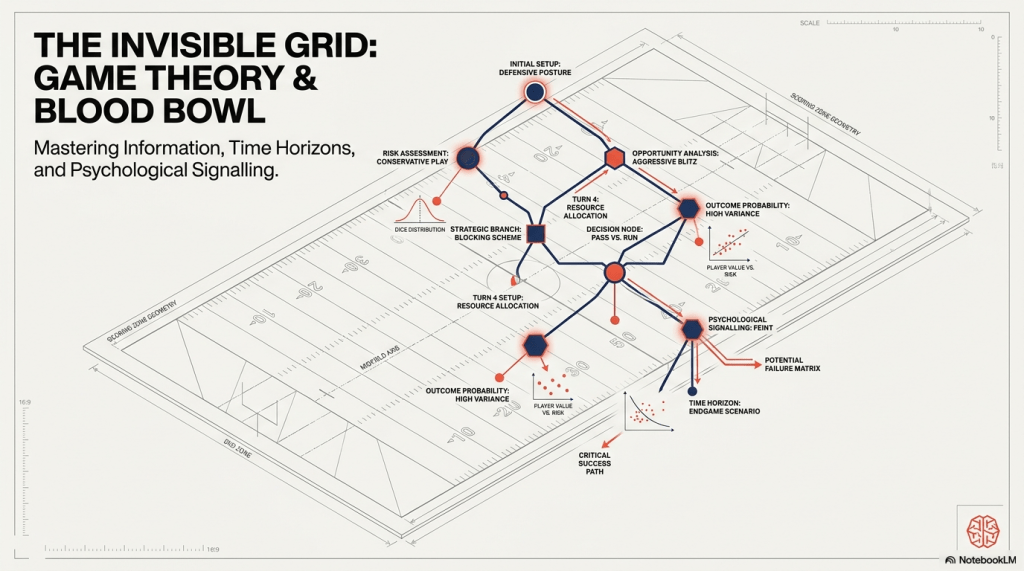
This is part 3 of the Game Theory series; links for part 1 and part 2
TLDR
- Strong play = matching risk to time horizon
- Early‑turn failures compound, because they shape many future turns; late‑turn failures don’t.
- Tempo and positioning snowball, early niggles can become late problems.
- Attrition is multiplicative, not linear; losing pieces early shrinks your option space for the whole drive. Each loss further reduces option space.
- Risk EV changes with time: the risk profile of the same play changes depending on timing. The risks may be disastrous on Turn 2, tolerable on Turn 12, trivial on Turn 16.
Time Discounting in Blood Bowl
The value of an action depends not only on its immediate effect, but when it happens. On how many future turns exist for its consequences to propagate. No surprises here; if your Wardancer dies turn 1 it affects the game in a different way than if they die on turn 14. The (potential) death of a ‘dancer is an obvious example and justification for at least considering using a RR for a failed dodge away from Tackle, especially where they will then attract a foul.
The other consideration is tempo (the subject of post #5). Consider a slow grinding team rolling a dub skulls or 1/9 early in a turn, early in a drive. Can you eat the roll or not? The turnover carries a risk of removal, but likely that specific risk is quite small; so the consideration becomes about the opportunity cost. Is the lost tempo of that action something that will spread across the rest of the drive? Positions won’t be developed and your opponent gains multiple turns to pressure a destabilised position. When considering the risk profile, what and when to RR, remember that identical risks carry very different meanings depending on when they are taken.
This perspective helps clarify why some plays* feel acceptable late in a half but reckless earlier on.
Early in the game, future turns amplify the success and failure states and make conservative lines with stable outcomes more valuable early. Later in the game, when few actions remain, the time horizon collapses and the future impact of failure shrinks. At that point, it can be correct to take risks that would have been EV‑negative earlier, because the cost of giving the opponent initiative is now limited by time.
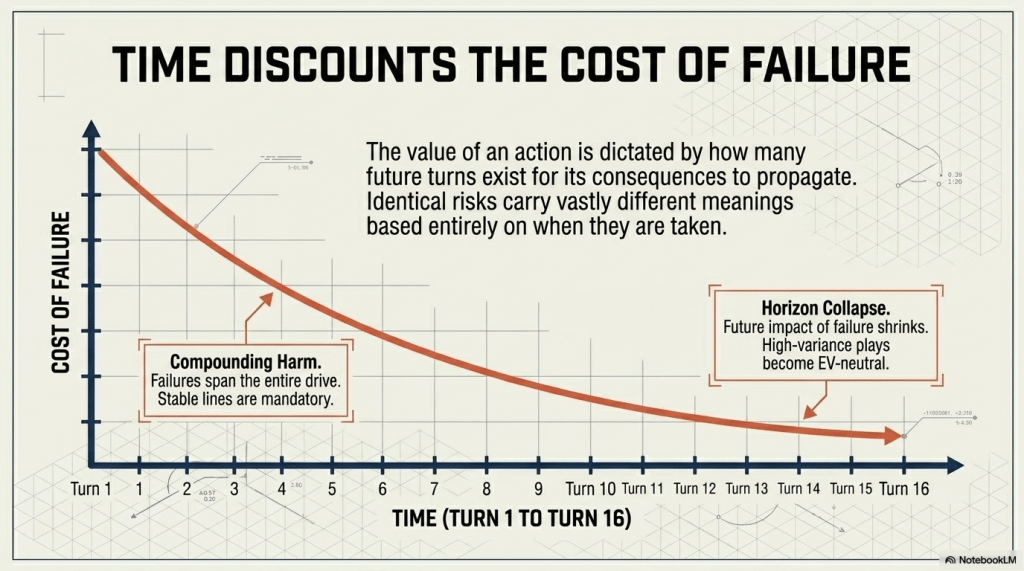
At the other end of the time horizon, late failures can be even more critical as there is no time to recover but those effects are likely to be obvious. The real challenge and skill differential is identifying the early actions that don’t look too bad at the time but which actually have long reaching impact. We can add “tempo reroll” to the tail risk reroll in the last section.
*Some plays are always reckless but sometimes the reckless chance is all you have.
Attrition as a Time Multiplier
Attrition refers both to the loss of players, and to the reduction of future options. Every piece removed early (not just Wardancers) weakens the current position and makes every subsequent turn harder by reducing available actions, assists, and threat coverage. These effects are not linear. Losing positionals or stars has big effects, but importantly, each successive player loss stacks to further remove options, forcing teams into predictable patterns that opponents can exploit. Yes, Elves can score with 3 players but it is much harder than with 4, 5 or 6. As a result, attrition acts as a compounding force, where early losses magnify later weaknesses. We’ve all suffered from snowballing.
Attrition cuts both ways and requires the ability to judge not only how to protect your own pieces or what to expose against when to invest resources in removing your opponent’s. Not all removals generate equal long‑term value.
Tying up multiple players early to chase a high‑armour, low‑mobility opponent usually damages your own positional development to a greater or lesser extent…. setting up a werewolf claw hit on a Treeman on the line of scrimmage hit on turn 1, for example, may represent high theoretical removal value and even a knockdown can take a while to recover, but if achieving it commits several players for multiple turns or allows a team split, then the net EV effect can be negative. The relevant question is not just “can I knock this player down?”, but “what positional cost does committing to this knockdown have?”.
Good attrition decisions therefore balance three effects simultaneously:
- The value of removing a specific opposing piece.
- The time available for that removal to influence the game.
- The opportunity-cost of committing players away from other positional goals.
Early in the game or drive is when you are likely to have the lowest opportunity cost and greatest time-to-value odds therefore you will often have the greatest flexibility on who to target for attrition blitzes. The EV + variance calculation here between hitting a lower armour defenceless piece vs a higher AV blodge piece should consider not just the relative removal probabilities but also the effect on your ability to start snowballing.
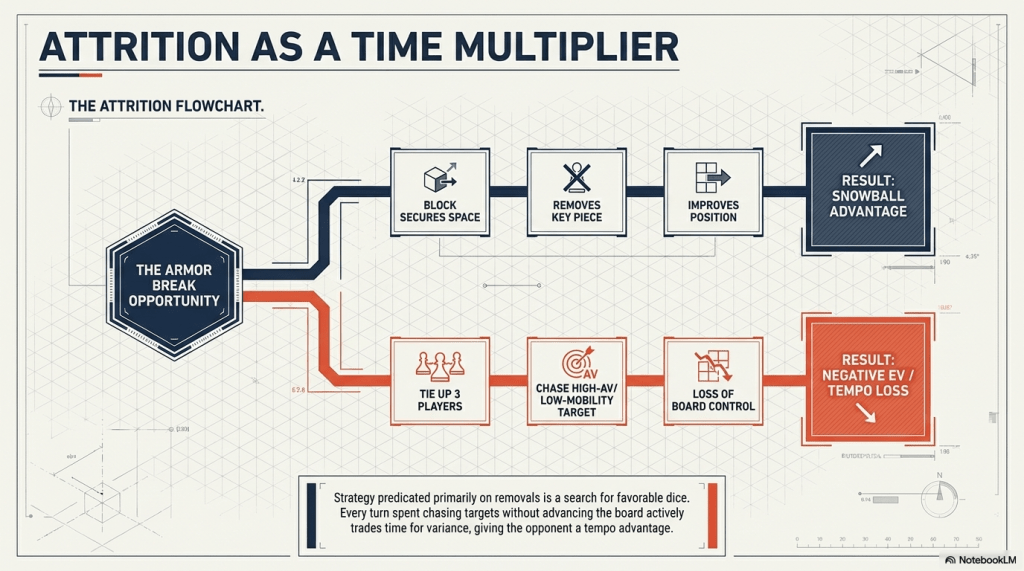
A word of warning; a strategy that is predicated primarily on removals is, at its core, a search for favourable dice.
An “Orc-smash” playstyle coach who bashes first and worries about the ball later will win games and will occasionally win vs good opponents. However, a plan that relies on removals alone, without concurrent positional progress accepts substantial variance by construction. Armour breaks, injury rolls, and casualty outcomes sit firmly in the tail of the distribution. Mighty Blow is not a fake skill, but even a statistically-advantaged bash team is never guaranteed to realise removals in a relevant timeframe. When such a removal-centric strategy fails to convert early, it often leaves the player having spent turns and resources without meaningfully improving position, tempo, or scoring prospects.
Strong opponents will limit the number of available turns available for pure attrition play. Every turn spent tying up players or chasing juicy targets without also creating or limiting space/options/momentum will negatively affect the tempo and therefore outcome of the drive. By actively trading time for safety, it is possible to force bash teams into a narrowing window where removals must occur quickly or cease to matter. As a result, attrition‑first strategies tend to produce bifurcated outcomes. Either early removals materialise and the game becomes increasingly simple, or they do not and the attrition-focused player finds themselves behind on position with no remaining time-horizon in which damage can compensate.
Removals are important, but that they must be contextualised correctly.
Attrition is most effective when it supports forward progress rather than replacing it. A hit that removes an opposing piece while also securing space, improving your cage, or limiting counterplay compounds advantage across multiple dimensions. By contrast, isolated blocks for damage alone increase reliance on favourable dice.
The point to take away is that good bash play is not entirely about maximising the number of blocks taken, but also about aligning removals with time and structure.
Before leaving this section, let’s acknowledge reroll type #3, the “greed reroll”. Rerolling failed block dice for the chance of getting an armour roll (and possibly foul) without really gaining meaningful positional advantage. To get the snowball rolling. Greed rolls can be a valid strategy, but likely only when you have many RRs available or where you need to inject variance to have a chance. Indeed, the opportunity to increase damage is why Team Captain on Orcs or Human teams is best placed on a Big ‘Un or Blitzer, for the chance to reroll pushes into pows, and increase damage potential.
Short‑Horizon and Long‑Horizon Thinking
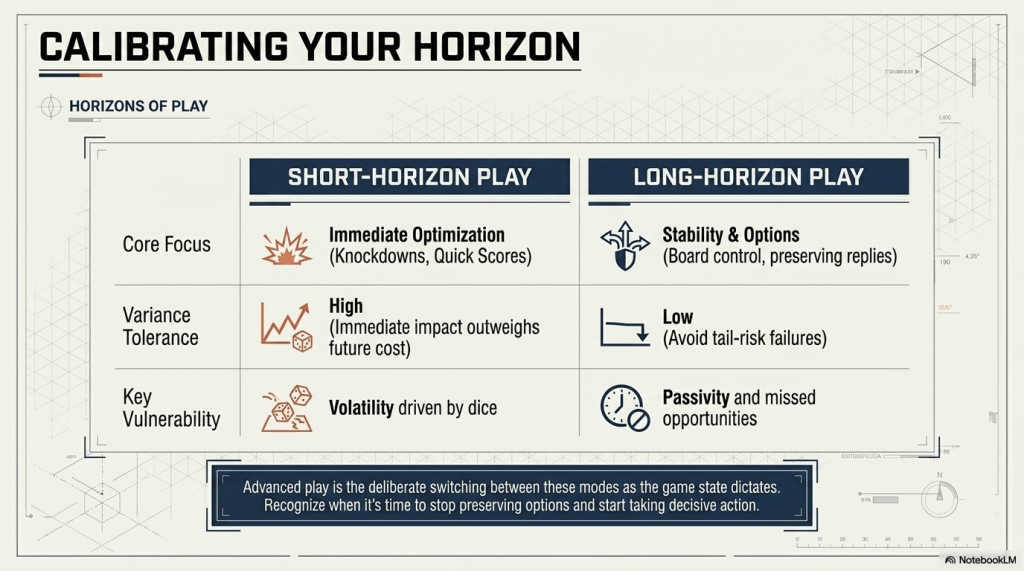
Blood Bowl constantly asks players to choose between short‑horizon gains and long‑horizon stability. Short‑horizon thinking focuses on immediate outcomes such as a knock‑down, a blitz opening, or a quick score. Long‑horizon thinking concerns itself with board control, attrition management, and preserving options for later. Neither mode is inherently superior and some race archetypes lean more one way or the other. The slower a team, the more you have to plan on longer-time frames.
Problems arise when players rely on one to the exclusion of the other. Excessive short‑horizon focus often produces volatile games driven by dice, while excessive long‑horizon focus can result in passivity that fails to capitalise on opportunities.
Advanced play involves switching deliberately between these modes as the game state changes. Early in halves, long‑horizon considerations usually* should dominate, encouraging stability and patience. As time runs out or as the score demands action, the balance should shift toward short‑horizon optimisation, where immediate impact outweighs future cost. Players who fail to make this transition often describe feeling as though the game “got away from them,” when really they simply continued to value future turns that no longer mattered.
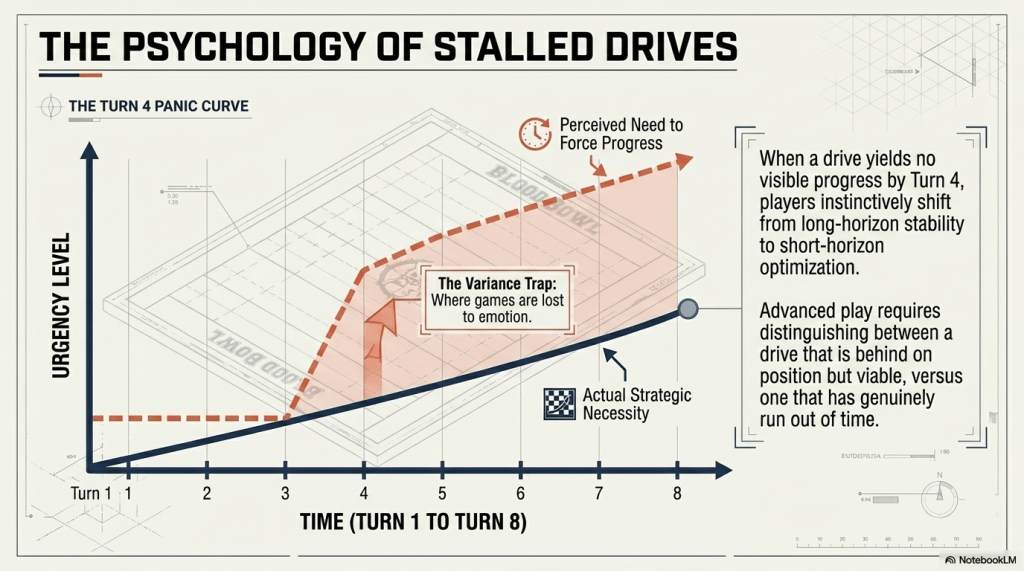
The example we can relate to here is “turn four panic”, the moment where the absence of visible progress begins to feel threatening. In most standard 8-turn drives, If the ball is not meaningfully advanced by turn 4 we feel an increasing need to force progress. Indeed, unless you are playing rats or woodies we probably should feel that panic! The effect of the panic is that risks that felt unjustifiable earlier suddenly become necessary (or at least appear so), and we inject variance. The strategic gain is being aware of this panic on either side of the board and exploiting it.
Advanced play, therefore, involves learning to distinguish between a drive that is behind on position but still viable, versus one that has genuinely run out of time for patient development and its time to start thinking about potatoes.
Combining EV, Variance with Time Horizon – Cage Diving
We said in one of the earlier posts that we’d return to the cage-dive scenario. Consider a defensive cage dive into a standard X cage. One player is needed to cancel defensive assists, and then one player dives into the 3 TZs with the aim of knocking the ball loose, getting a favourable scatter, then recovering the ball, and escaping behind a protective screen. The probability of full success is usually low, on the order of a few percent without committing rerolls, maybe rising to 10% with up to 2 RR invested and/or relevant skills. However, the upside is potentially game winning. If the dive works, it can lead to a counter‑score or prevention of an otherwise inevitable touchdown. If it fails, the immediate positional damage might be modestly suboptimal relative to entering a defensive screen. However, the players involved face a risk of removal either directly from the failed dodge or from getting punched/fouled/surfed on the following turn.
Superficially, this cage dive action looks identical regardless of when it is taken. In practice, its EV and variance depends on when in the game it occurs. Let’s consider three identical diving scenarios separated by time; turn 2, 13 or 16.
A successful dive on turn two creates a large but potentially distant advantage. The reward could be quickly running off to take a 1-0 lead on T2 or 3. Even then, your opponent could still score on Turn 8 and you go into the second half “winning” 1-1. That’s pretty good. Better still you might be able to turn the whole half into “your” drive and then lead 1-0 at half. Huge. In contrast, the cost of failure could compound. The best-case failure could be two of your players being knocked down but otherwise fine, but worse case is losing both players. If this happens it would degrade your ability to contest the remainder of the drive AND (likely) undermine your own offense in the second half. The hypothetical outcome distribution reflects this asymmetry. Three bumps; a small probability of major success, sits alongside a higher probability of a small amount of EV loss (this represents the harm from positional loss compared with the alternative of not diving and entering a screening formation), and another two bumps representing the small probability of persistent harm through player removals. The overall EV of the action may be slightly EV net-negative with the probability mass split more heavily weighted to toward the negative.
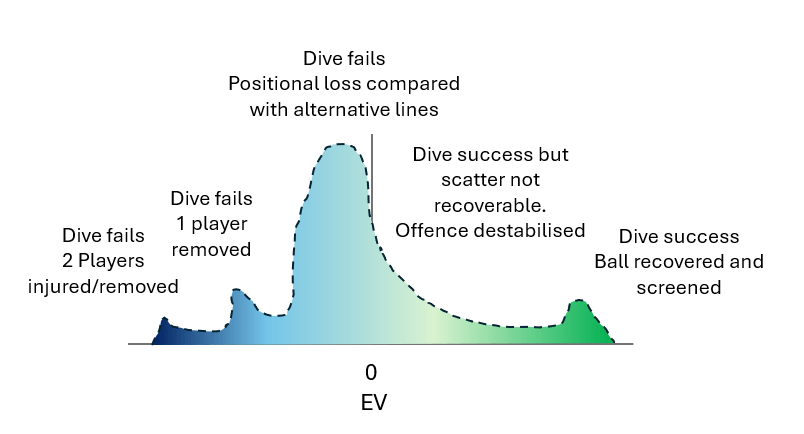
As the game progresses, the same action reshapes its profile. Turn 13’s version of success and its long-term effect on the game outcome is clearer. Importantly, failure and potential attrition impacts affect a smaller number of turns/drives, likely not having a major impact on your own offence unless it’s a key piece for your one turn TD attempt. The the attrition penalty still exists, but now the time horizon is narrow. Overall the net expected value is likely around neutral, we’ve removed/reduced some of the big negative contributors and there are more outcomes that will positively affect the drive. Indeed, any outcome that destabilises the offence could help you successfully stop the drive. Variance remains high, but the cost of it going wrong is now bounded.
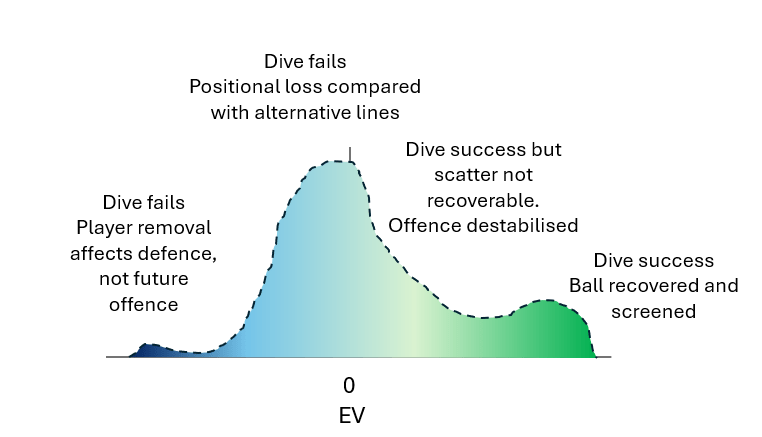
The turn sixteen version sees the curve almost completely changed relative to turn two. Success now directly denies a score, although it may not lead to a counter score, a stop could be game-winning in its own right. Failure carries (almost) no future cost in terms of attrition (in a resurrection tournament setting). Position can matter: going for the dive rather than being in a better defensive posture is the only negatives to the calculation.
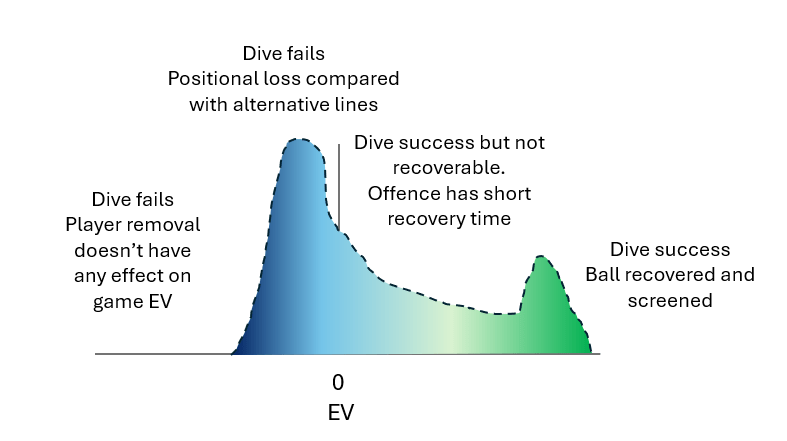
The probability of the dive success/failure outcomes is unchanged throughout these scenarios. What changes is the meaning of failure.
The core message here is not specific to cage diving. Indeed it is important to acknowledge that cage diving doesn’t automatically become the best play as the game goes on! The coaching decision point, is the side-by-side comparison vs what the alternative line of play. The point to takeaway is that the EV and distribution of variance for a play is modified by the time horizon.
A couple of notes and caveats.
Firstly these are contrived thought experiments. The real game state is never going to be identical. There is also a further thought process to consider “is this the best chance I’m going to get”. This is especially relevant when playing with a low AV aggressive team (I’m looking at you Skaven). When playing with rats, my long-horizon consideration includes the sadly very real prospect of running out of rats.
Secondly the probabilities of the different outcomes and therefore the shape of the curve changes to reflect the pieces involved e.g. a dive with an AV9+ High Elf has lower self removal odds than an AV8+ Elven Union piece with the same skills, or exposure of a Skaven lineman to cancel assists may not have a substantial negative effect if the rats have a deep bench to draw on for their offensive drive.
Using Game Theory to Improve Your Performanc
Review
Develop the habit of explicitly considering how many future turns are affected by a decision and adjusting your risk tolerance accordingly. After games, review early‑turn failures and ask whether it was the right time; would the same play have been more acceptable with fewer turns remaining? Improvement in this area is visible when your early turns become calmer and more structured without reducing your willingness to act decisively when high EV possibilities are present and to change aggression levels later in the half.
If you are a bash-first coach, an important personal progression point is recognition when suboptimal results weren’t because of poor removal dice but rather that your playstyle didn’t adapt to the game being played.
To improve in your removal-hunting and attrition economics, actively evaluate your blitz-target choice particularly the early turns in drives. Rate each action in terms of opportunity/positioning cost. Did you correctly value target quality vs position. With the benefit of hindsight you will be able to evaluate how your opponent used the space you left, giving you feedback on the cost-to-value of the action. Formalising this post-game analysis will help you to identify when your personal blood lust is hurting your game and you can then take that forward into future matches. Also frame the analysis around time horizon by scoring the target selection not just by the importance of the current action, but by how many future turns depend on that piece remaining available.
Practice
In practice games, look at making the switch between time-horizons explicit as the game evolves. One exercise is to ask yourself at the start of each turn whether the current game state rewards preservation or decisive action, and tailor your choices according to that assessment. The first few thoughts on every turn should be what turn is it, where am I, where do I need to be… is It GO time? Improvement in this area is marked by fewer situations where urgency arrives too late AND, on the flip side, increasing how frequently your opponent reaches their critical GO time earlier than they want.


 CLAW Blood Bowl
Leave a comment