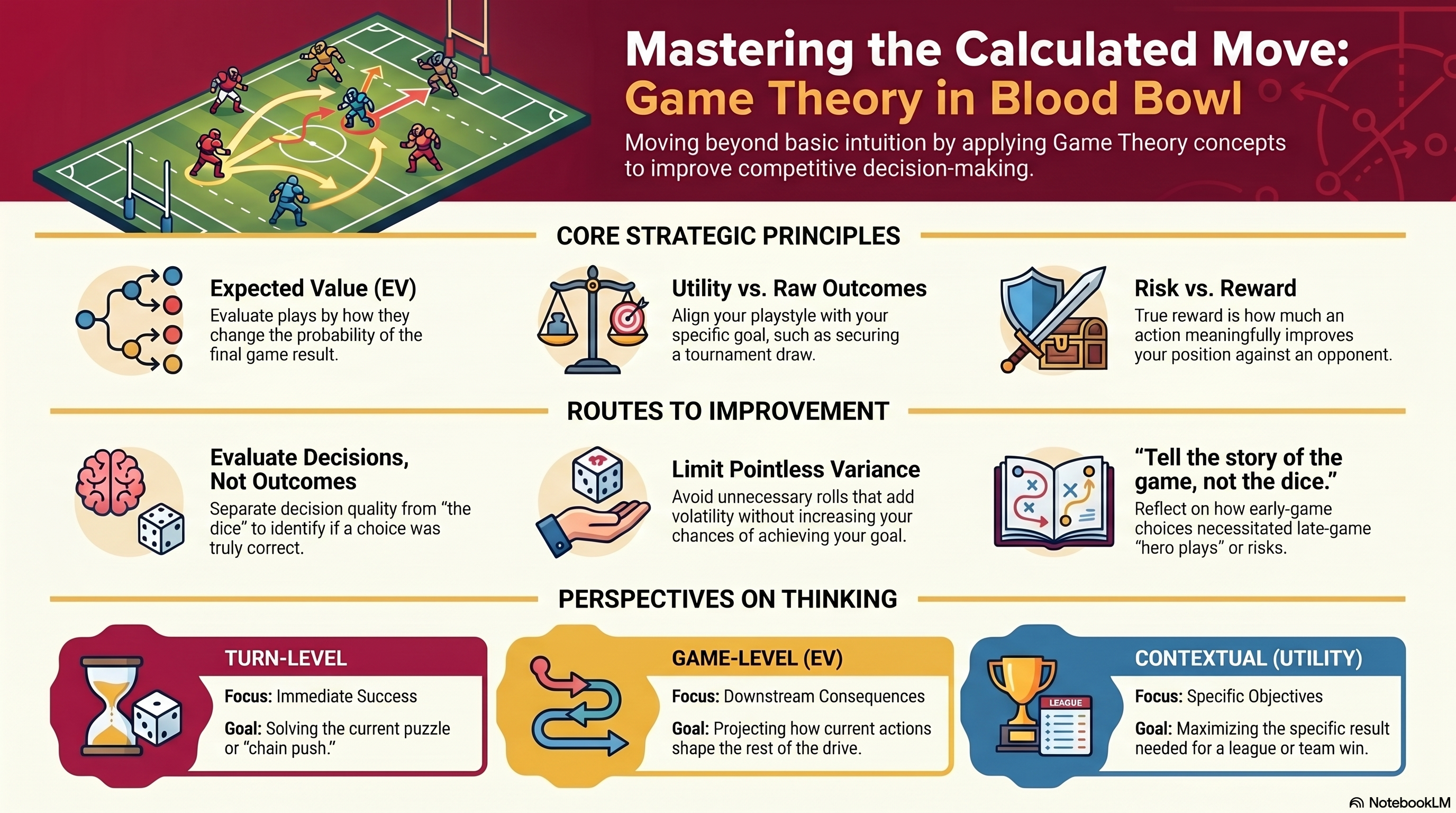

This is a meaty post… so here are the learning objectives:
TLDR
- Judge decisions by process, not outcomes: good plays can fail and bad plays can work, focus on whether the decision increased your chances overall.
- Think in terms of game-level EV, not single turns: evaluate how actions shape the rest of the drive or match, not just immediate payoff.
- Be explicit about your objective (utility): the “right” play changes depending on whether you need a win or to avoid losing.
- Understand real risk–reward: it’s about how outcomes affect future game states and options, not just the odds of success or failure.
- Improve through reflection and deliberate practice: analyse why you needed certain risky plays and identify where earlier decisions reduced your margin for error.

After many discussions with BB Jock, Scotland captain, about Game Theory and formulating ideas for the Scottish BB Team training weekend, I wrote a doc for the squad about Game Theory concepts and routes to improvement. That doc grew legs and arms as the deeper I delved into the topic the more I appreciated how the concepts could be applied to our game.
I’m going to share the musings here over a few separate posts and hopefully they will be useful.
Each post has a little bit of theory and ends with some concrete steps you can take toward improvement. If you want access to the whole doc, shoot me a message.

Why Game Theory Belongs in Blood Bowl
Game Theory is the study of decision-making in situations where outcomes depend on the choices made by other agents who are also trying to achieve their own goals. It is a framework that considers incentives, trade‑offs, and interactions under uncertainty, particularly in situations where information is incomplete and decisions have lasting consequences.
Most experienced coaches already use Game Theory ideas. We just do it intuitively.
In Blood Bowl, we play with incomplete information, asymmetric risks, irreversible commitments, and incentives that change with time, score, and opponent behaviour…precisely the conditions that Game Theory was developed to study.
What follows is an attempt to reframe the intuition we’ve gained through experiential learning and identify routes we can use to improve. We already know when to stall, when to rush, when to risk a hero play, and when to turtle to shut a game down. Through experience, you will have internalised how tempo matters, how attrition compounds, how pressure constrains opponent choice, and how psychology shapes decisions. However, intuition and experience develop unevenly, they are shaped by memorable successes and failures, local metagames, and personal habits. This makes intuition reliable in familiar situations (it’s why I always beat Dave!), but less dependable when conditions shift.

We all know that every BB game is unique; the goal is to identify lines of thought that can be applied to a range of scenarios, whether or not you’ve been in a similar spot before.
Making ideas such as expected value, variance, information theory, etc explicit, should allow you to examine why a decision felt right or wrong independent of its outcome, and to recognise when a familiar instinct is appropriate versus when it is being applied mechanically.
The changes to your play are unlikely to be dramatic if you are already playing at a decent level. No big epiphany incoming. Reaching the upper echelons of our game involves small, contextual micro-improvements that reduce the frequency with which good instincts are misapplied. Over many games, they will (or at least should) accumulate into greater consistency and a higher win-rate.
1. Decision Value and Uncertainty
Choose futures, not plays.

Expected Value
Expected Value (EV) is a way of evaluating decisions based on their influence on the future: what game-outcome (win/draw/loss) becomes more likely as a consequence of those actions. It’s a central tenet of Game Theory and we’ll keep coming back to EV.
Expected Value is the average impact of a line of play/choice on the overall game result.
We all know anyone can roll snakes/quads at any time. Good decisions can fail and poor decisions can succeed. Thinking about actions in terms of their effect on EV allows players to do two things. Firstly, it allows us to separate decision quality from outcome quality.. “There are no dice!”. Secondly, it formalises our decision making process, which helps us to decide between binary outcomes, the most obvious example being deciding on reroll (RR) usage.
At higher levels of play, you rarely see errors from misunderstanding the relative odds for two different individual lines of play. Everyone can work out, for example, if it is better to dodge, rush and pass vs perform a longer pass. Actual quality-level differences come from applying EV at the wrong scale; thinking in turns rather than games. A single critical turn is quite easy to master (I love the puzzle solving aspect of a series of chain pushes, as you can tell by my puzzle pages). However, to win games consistently requires projecting how short-term decisions shape the rest of the drive or the game. A block that is favourable in isolation may still be game EV‑negative if it leaves a player isolated and unable to contribute meaningfully later in the drive. Thinking in terms of game EV encourages players to evaluate decisions based on their downstream consequences, rather than their immediate appeal.
Utility Versus Raw Outcomes
I said earlier that EV referred to the likelihood of winning or losing, but that needs a little more nuance. Yes, individually we want to win every match and in a one-day singles tournament, a drawn match usually means you aren’t in contention to finish top. However, in a team event or league, a draw may be sufficient if it secures the round or gets you into the playoffs, and in most of the big two-day tournaments this year a 5-1-0 record was sufficient, so sometimes it is important to not-lose.
Utility refers to how valuable a game outcome is in the current context.
EV calculations must reflect the utility correctly. If you only need a draw or better, then EV calculation should be whether a line of play increases or decreases your chance to achieve a draw or better rather than its effect on win chance. This means that in draw+ scenario, a play that increases the chance of a win but also increases the chance of a loss should be considered as EV negative compared with a line of play that doesn’t increase the chance of losing by as much.
This distinction helps explain why experienced players often disagree about whether an aggressive play is correct. They may be implicitly valuing outcomes differently rather than disagreeing about probabilities. One player may be maximising the chance of winning the match outright, while another is maximising the chance of avoiding defeat. Both approaches can be rational under different utility assumptions. Making utility explicit clarifies these disagreements and allows decisions to be evaluated more coherently.

Risk–Reward Trade‑offs
A play with moderate odds but limited downside can have lower Game-theory-risk than a play with higher odds of success but catastrophic failure states. You know this already of course: a 2+ dodge with Dodge with the ball carrier feels different and is different from a risk perspective than a 4+ dodge from a random skeleton away from the action. Reward, similarly, should not be confused with immediacy, but with how much an action meaningfully improves your position relative to your opponent (what does it do to your game EV). High‑reward plays are those that substantially alter the set of future game states in your favour.
Risk and reward are often spoken about loosely in Blood Bowl, but Game Theory can tighten-up that thinking. Risk is not simply the likelihood of failure and reward is not just the immediate.
Risk and Reward are the extent to which game outcomes diverge from the average when success or failure occurs.
A classic hero play is a cage-dive to sack the ball carrier. It’s a useful play that we can all visualise so we’ll keep coming back to this example. The turn-level probabilities of making the dodge in and the hit getting the ball free are easy to calculate. The risk calculation can be calculated with the immediate risks of the probability of armour break and removal risk to the diving piece. However, the full risk must also capture the loss of future agency from loss of that piece and use of any rerolls and what the sack attempt gives up in terms of defensive shape/field position.
The true “reward” aspect of the calculation needs to consider ball scatter location and recovery potential and probability of opponent recovery on the next turn and also how late in the drive it is happening.
Understanding risk–reward trade‑offs requires thinking in terms of distributions rather than single results. Many hero plays offer high apparent reward because success is decisive, but the average improvement in winning chances (EV) may be smaller than expected once failure is accounted for. Conversely, slow, unglamorous plays often have lower variance and modest reward, but can dominate EV over games by steadily constraining the opponent and preserving position.
Please be very clear; we are not advocating for or against risk-averse play as a general concept. Advanced play involves recognising when to favour stable play versus when the situation demands a deliberate increase in risk. The next post will build on this.
Using Game Theory to Improve your Results.
Reflection
First, and this really will help you most to progress as a player, develop the habit of evaluating decisions based on the decision rather than the outcome.
Then move on to developing the skill of evaluating the decision based on its effect on the game rather than on the turn.
In terms of utility, the goal is to make outcome valuation explicit rather than implicit. Before each match, especially in team events, identify what result genuinely advances your overall goal. Note that during a game, your outcome valuation may and often will change (e.g. if your opponent got 4x first-turn removals) but again make the evaluation explicit*. After the game, reflect on whether you could have won (this reflection will help future decisions), but also reflect on whether your decisions correctly prioritised the outcome that mattered.
A useful self‑test is whether, when reviewing a game you lost, can you separate decisions that reduced your chances of achieving your objective (W/D) from dice that merely realised that reduced chance? Was the choice wrong or was it really the dice? If you cannot articulate that difference, your EV judgement is likely still centred too tightly on immediate outcome. When you are telling your buddy about the tripwire into the endzone on T16, yes, bemoan the snake, snakes suck, but also consider why you needed the rush to get there; reflect on whether the decisions earlier in the drive that left that player short were correct.
Tell the story of the game, not the story of the dice.

Practice
Reflection helps you to see where improvement is needed but you have to put it into meaningful practice.
To build the skill of evaluating game-level EV rather than focusing on immediate actions during game play, start by pausing briefly before committing to any optional dice roll and asking yourself what the game looks like two turns later if this fails. If the answer is “substantively worse”, treat that as part of the decision-making process. It doesn’t mean the decision is wrong; you have to take some risk, but actively acknowledging what you are risking will improve your decisions.
Learning to avoid pointless, unprofitable risk involves becoming able to distinguish between plays that add upside and plays that merely increase volatility, then having the discipline to minimise risk when the EV remains unchanged.
We don’t talk enough about the value of meaningful practice in BB. We tend to just play games. An option to shift your EV thinking is, while playing a standard game, to practice deliberately choosing lines that optimise for a draw by reducing losing risk. They might feel conservative or emotionally unsatisfying* but you practice so that you are better when you need to play in this way.
Conversely, in any game (not just training games), you can practice evaluating what you would do if playing for a draw vs playing for a win. Identify aggressive lines and draw-focused lines for each inflection point in the game. Being better at recognising fundamental choices will make you a better team player.
The habit to develop here is naming what success achieves and what failure costs in terms of board state, player availability, and future options. Over time, the aim is to reserve high‑variance actions for situations where volatility improves your chance of achieving your defined objective.
*You don’t need to tell your opponent you have shifted to playing for a draw at best… but your team captain will certainly value the knowledge that you are scrambling for a draw!
**Blood Bowl is a game; we don’t advocate for choosing emotionally unsatisfying lines! But in a team event, you should place greater emotional investment in the team-round result than your individual match.
On to the next sections
Topics of future posts (these will become links once posted)
- Controlling the Choice Set
- Behavioural Game Theory and Psychology
- Resource Management
- Initial Conditions and When Intuition Fails
- Final Synthesis: Applying the Lens
Thoughts, comments?
AI – The images in this post come from NotebookLM. To use this type of genAI you direct the AI to defined sources. Here, I wrote this doc then provided just this doc to NotebookLM, it then used my source to create the illustrations. I’ve included the content as I think they are pretty decent additions rather than AI slop.

Leave a Reply