
Part 2 of our series on Game Theory and Blood Bowl – read part one here.
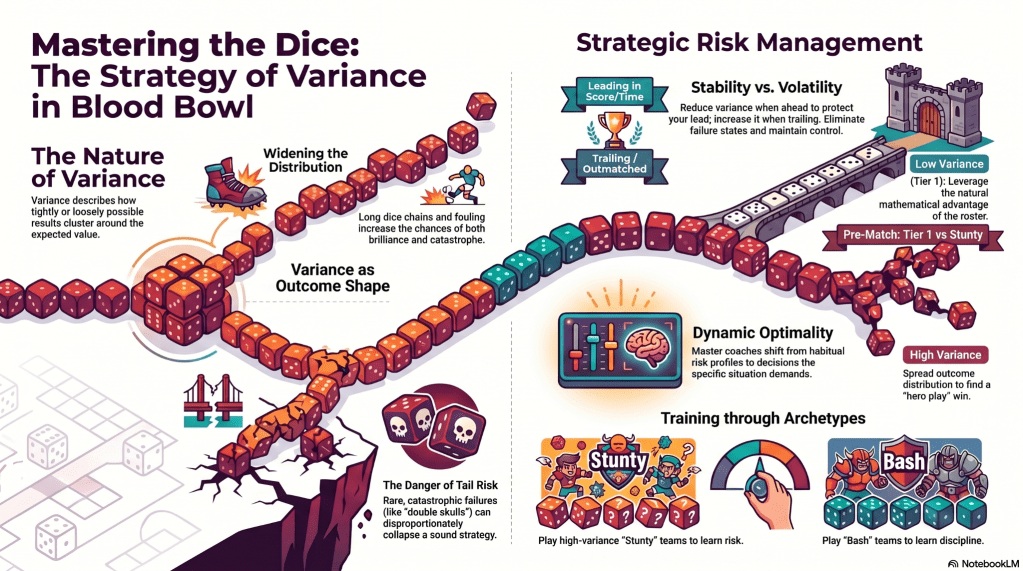
Variance as Outcome Shape
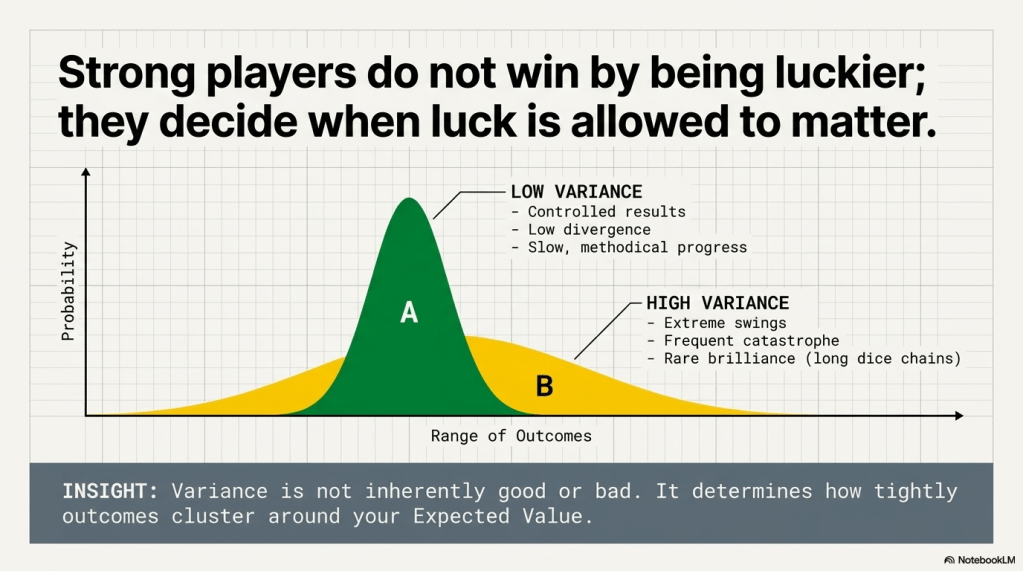
Variance describes the shape of possible outcomes around an expected value. While EV tells you where the centre of outcomes lies, variance determines how tightly or loosely those outcomes are clustered. In Blood Bowl terms, variance distinguishes between games that tend to be decided by a small range of results and games that regularly swing between extremes. Two plays (or playstyles) can produce the same average win rate over time while feeling completely different to play – one could produce controlled, predictable results and the other produces rare brilliance or frequent catastrophes.
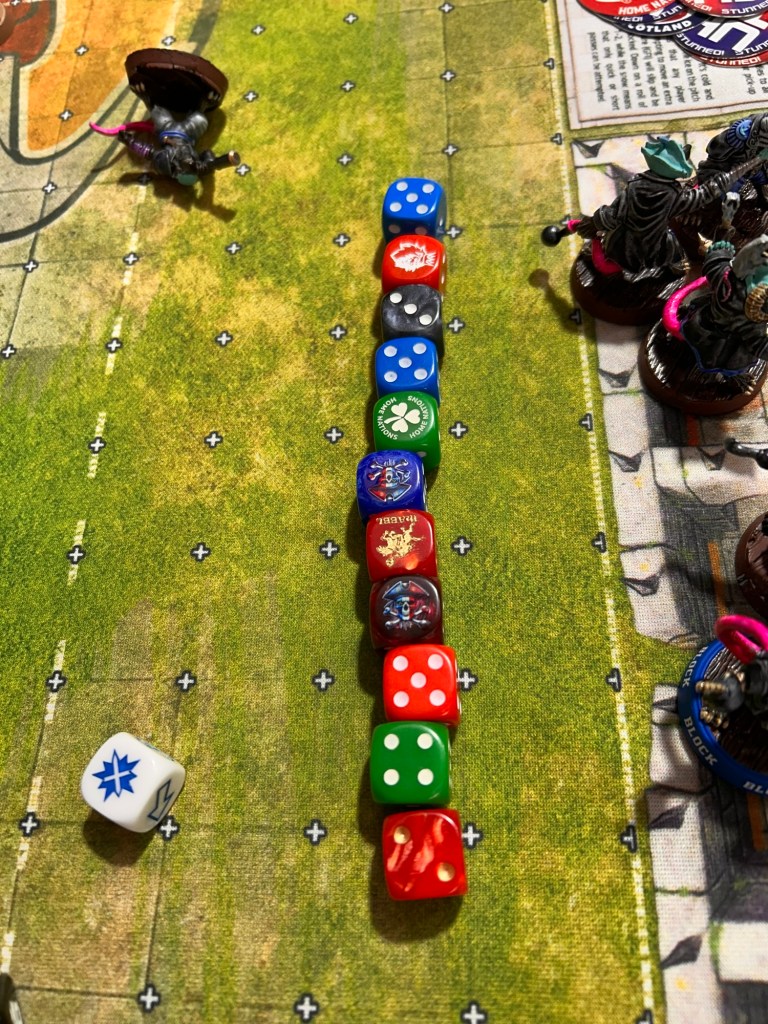
Thinking in terms of outcome shape rather than success rate helps decision making. Actions that involve long dice chains, early reroll commitment, or exposure of important pieces tend to widen the outcome distribution. These plays increase the chance of both winning and losing. The dice chain below was a particularly exciting play that came off with my heavily depleted rats (see injury box… the boys are falling out of it its so packed). With the few who were left, we dived in, 1D powed, popped the ball out and then rolled all the dive to get away downfield. Definitely low probability!
Similarly, fouling is a high variance action with potential for large upsides at the risk of a clear downside. For fouling, the width of the outcome shape is modified by factors such as the value of target and the fouler to their teams, the depth of bench for both teams, how deep into the drive/game, and foul modifiers such as assists, skills, AV of target, and bribes, biased refs, prayers etc.
Managing Variance Deliberately
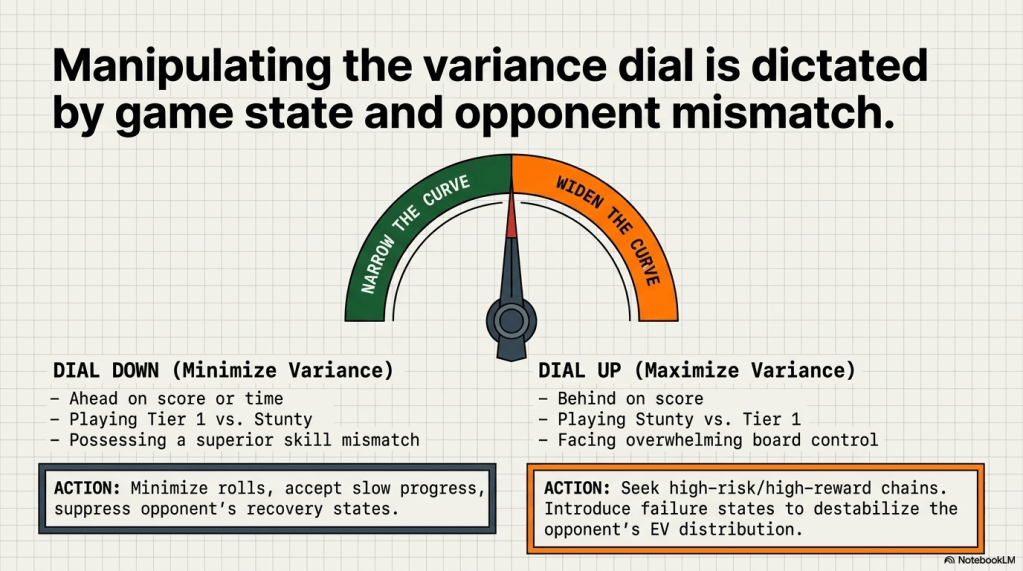
Variance is not inherently good or bad. Its value depends entirely on the current game state and objectives. When you are ahead on score, position, or time, additional variance tends to harm you by introducing failure states that allow the opponent back into the game. In these situations, actively reducing variance by limiting dice rolls, protecting important players, and accepting slow progress often maximises win probability even if it feels passive. Conversely, when you are behind, stability is likely to not be good enough. If the existing EV distribution overwhelmingly favours your opponent, increasing variance may be the only way to meaningfully improve your chances of success.
The real skill is in correctly identifying both when and by how much to increase variance. It’s not easy. Indeed, many players either subconsciously seek to feel in control, which can lead them to suppress variance too much, even when losing, or conversely to go too high risk too soon. It can also be a problem when winning – taking riskier lines than necessary. It’s quite common to see an elf coach rolling 8x 2+s to try to get to 2-0 in two turns, rather playing a slightly slower drive without as many critical failure risks. Advanced play involves recognising which side of the distribution benefits you and adjusting your decision‑making accordingly.
Pre-match you might also consider the racial matchup and strength of your opposing coach as two relevant modifiers to your variance appetite. An obvious example is a stunty team playing against a tier 1 race. The game design means that if both players play a low variance playstyle, the stunty team will lose more often than the tier 1 team. Therefore, it is in the stunty coach’s interest to increase variance (in a controlled way) to spread the outcome distribution. Fouling and TTMs are on the table. In contrast, the tier 1 coach should usually plan to play a tighter and more controlled game. If you are up against one of the best players in the world or someone playing their first ever tournament your appetite for variance should reflect the matchup.
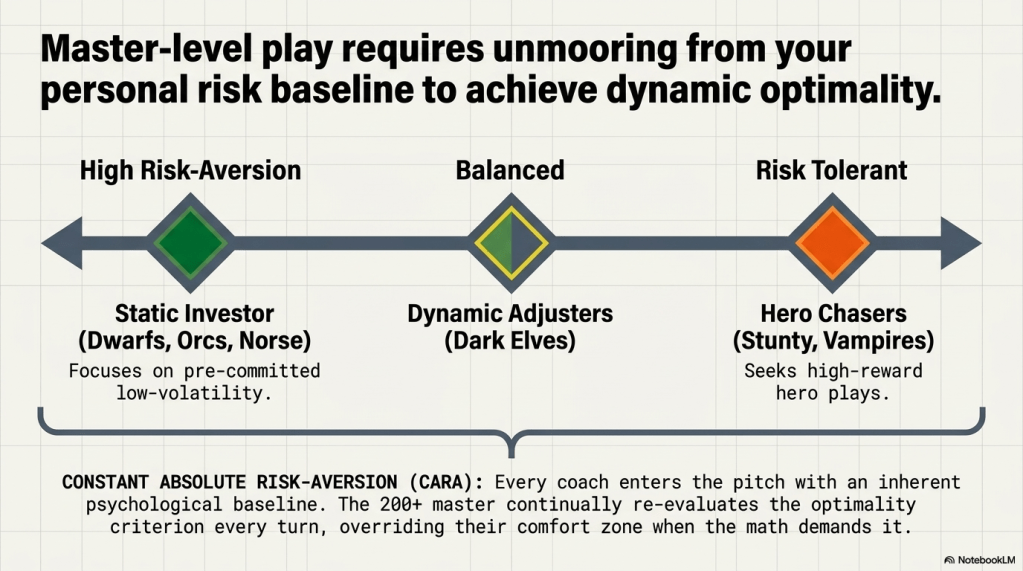
Let’s add another layer…time for some self reflection. Every coach enters the pitch with a unique personal risk profile, a psychological baseline which is described in utility theory as Constant Absolute Risk-Aversion (CARA). This inherent “alpha,” or coefficient of risk aversion, defines a coach’s comfort level with the spread of possible outcomes caused by the dice. A coach with a high baseline for risk aversion acts like a “static investor” who stays pre-committed to a strategy that minimises volatility. During early development, they will naturally favour resilient teams like Norse, Dwarfs or Orcs that focus on low variance optimisation, or will play Dark Elves as an Elf column team. Conversely, a more risk-tolerant coach, might naturally gravitate toward Stunty teams, Chaos Renegades, Vampires, Slann etc or play Dark Elves as a disrupting team with high press and cage-diving. Where the potential reward for low-probability “hero plays” is high enough to compensate for frequent failures.
The transition from an intermediate player to a master (200+) requires shifting from your fixed personal baseline toward dynamic optimality. Higher level coaches continuously re-evaluates the optimality criterion during every turn. Understanding when a high-variance play is mathematically the best option if the alternative is a guaranteed slow defeat. This is true on both sides of course, you should evaluate from your opponent’s perspective and don’t be surprised when they pivot to taking on a 5+, 5+ option when previously they would turn it down.
Tail Risk and Catastrophic Outcomes
Not all failures are equal. Average EV gain isn’t everything.
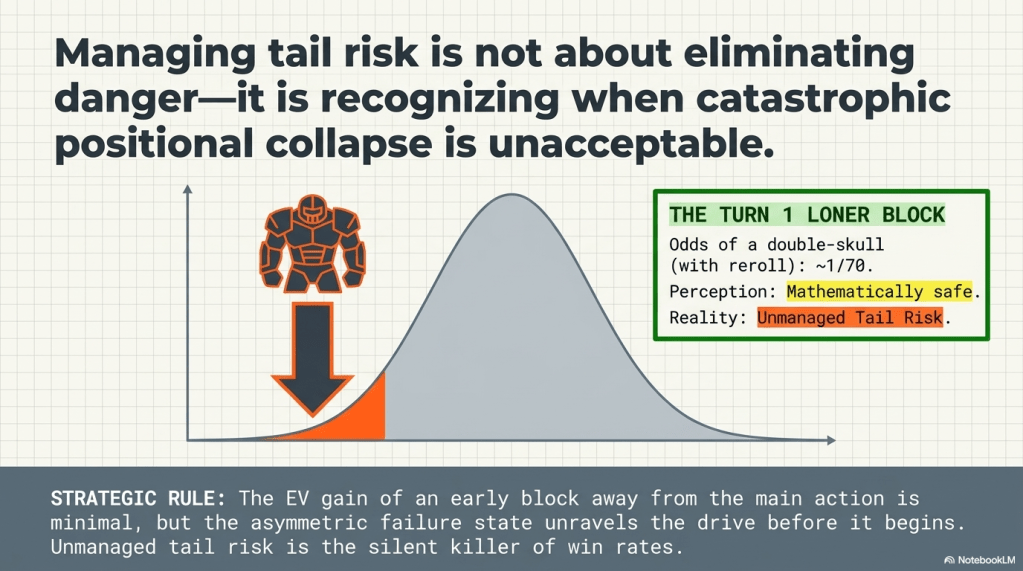
Tail risk refers to the small probability of extremely damaging outcomes that sit at the far edge of an outcome distribution.
In Blood Bowl, tail risks commonly involve ball-down situations, but also include permanent player removal, complete positional collapse, or irrecoverable tempo loss. These outcomes may be unlikely, but their impact is so severe that they can dominate the true cost of a decision if not accounted for.
Managing tail risk is less about eliminating danger and more about recognising when catastrophe is unacceptable. This can mean that conservative choices that appear overly cautious when viewed purely through expected returns can be situationally correct. Positional retreats, and declining unnecessary blocks function as tail‑risk controls rather than means of improving average outcomes. Players who ignore (fail to protect against) tail risk tend to experience sudden, sometimes confusing, losses where a game flips from being in control to unwinnable in a single turn.
Consider two commonly observed but inherently risky behaviour.
First: taking a block with a big guy early in a turn. If the player has Block and Loner the overall odds are ~1/70* with RR for dub skulls (worse than a non-Loner Block-less 2D (1/81)). Pretty safe, but the problem is when the action carries a low risk but highly asymmetric failure state. Early in a turn, and especially early in a drive, a turnover can unravel an otherwise sound plan before it has even begun. When the decision to block was taken based solely on the opportunity, e.g. away from the main action (“big guy SMASH!”), then the expected value gain is likely to be minimal, while the tail risk of sudden positional collapse is real.
Second example: taking unnecessary hits before scoring at the end of a half. Here the failure effect is instantly obvious and could define the scoreline. The prospective EV gain of even a 2D block with Block and a RR available leading to removal has to be very high to justify the failure risk.
From a game‑theory perspective, these are classic examples of unmanaged tail risk. A low‑probability event sits at the extreme end of the failure distribution, but when it occurs its impact is disproportionately large.
Management of tail risk also includes resource management (a topic we’ll come back to later in this series); having a “tail-risk reroll” available will rescue many drives!
Using Game Theory to Improve Your Results
Review
Develop the habit of classifying your decisions by how much they widen or narrow the EV variation rather than by their odds alone. To support this, examine pivotal plays after a game in terms of whether they made your position more stable or more volatile. As always, look at these independently of whether they succeeded or not (judge the decision, not the dice).
The next step is to get better at deciding the correct level of risk for the situation. This is difficult to get right, but the first stage is being aware that there are pivot points where changing variance-tolerance is appropriate. In review, explicitly assess on each turn whether your current position benefits from more/less stability or volatility, and reflect on whether you pivoted between positions at the correct time. Also, whether the change was appropriate or too far…it is easy to enter desperation mode too soon. Progress will becomes evident when you are aware of the choice to take or avoid risk and the decisions feel situational rather than habitual; it’s not what you usually do, it’s what the situation demands.
During post‑game analysis, identify moments where a low‑probability event caused disproportionate damage and ask whether that risk was necessary. Should you really have opened the turn with a blockless 2D? Improvement in this area will be evident when your losses come from sustained pressure rather than sudden collapse.
Review your replays specifically for actions like unnecessary rushes*, dodges and possibly 1D blocks. Ask whether the variance added exceeded the value. If you have already secured the mean outcome, any additional dice roll could be “pointless variance” that risks a turnover/attrition for zero added utility.
*I also recommend counting or at least being aware of the number of rushes you do per match (in general) and then specifically look at each one and decide whether the risk to value ratio was in your favour. Rushes aren’t free movement and each rush should be evaluated.
Practice
To train yourself to adapt and become comfortable in different risk profile situations you could try archetype exposure. If you are (or your gaming-group friends) identify you as a coach who plays in a naturally risk-averse way, you should choose to play a series of games with a Stunty or other high variance team to learn how to solicit “good variance”. Play these games deliberately leaning into the higher variance playstyle rather than suppressing it.
Conversely, if you are overly risk-tolerant, you can improve by playing a resilient bash team to practice the discipline of avoiding unprofitable variance. You could push this further by choosing a build with fewer rerolls and drop any Loner/Negatrait Big Guys. Again, the goal is to lean into stability by playing pitch and space control as your primary playstyle, and learn how to play in a low-risk stylel. You may or may not enjoy the different playstyle, but the purpose of these series is to become more comfortable when you need to transition. Playing in a different style will also help you look at the board from your future opponent’s perspective.

 CLAW Blood Bowl
Leave a comment